CASE STUDY 01
WORKFLOW REDESIGN

From Fragmented Execution to a Structured Operating Model.

Transformed a fragmented federal subcontracting workflow into a more controlled, visible, and predictable operating model—improving speed and control, reducing risk, and execution visibility.
PROCESS DESIGN
OPERATIONAL EFFICIENCY
CONTROL VISIBILITY
- 30%
CYCLE TIME
20+  → 14 days
14 → 5
ROUTING TOUCHES
Reduced handoffs
97%
ON-TIME DELIVERY
Improved predictability
THE PROBLEM
Current-State Performance Gap

Within the federal subcontract execution workflow, the current-state process required over 14 routing touches across multiple systems and manual tracking methods, with an average cycle time over 20 days, documentation completion of 72%, and on-time delivery of 84%. The fragmented process increased reconciliation effort, limited end-to-end visibility, and reduced the predictability of contract execution. The fragmented process increased reconciliation effort, limited end-to-end visibility, reduced execution predictability, and increased audit exposure through incomplete or difficult-to-trace control documentation.

Observed Friction

• Manual email routing
• Multiple approval handoffs
• Disconnected tracking systems
• Incomplete documentation
• Limited status visibility
• Audit risk
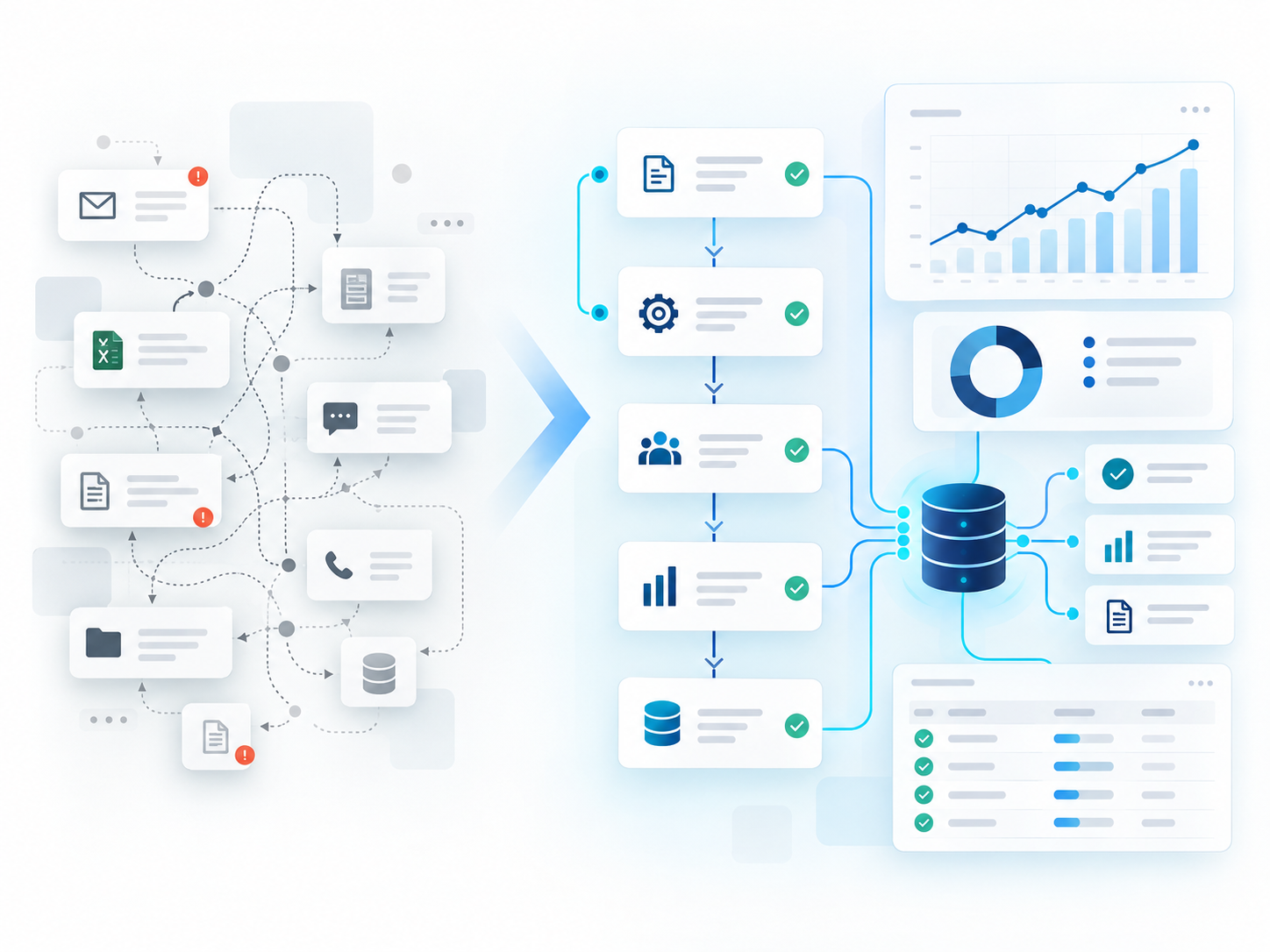
BEFORE → AFTER WORKFLOW

From Fragmented Handoffs to Controlled Execution

BEFORE

Fragmented & Manual

Request or Cold Receipt of RFQ → Intake → Meeting on RFQ → Email Routing  → Manual Review  → Meeting on Revisions → Approval Process → Subontractor Review → Redlines → Meeting on Redlines → Subcontract Negotiations → Revised Contract → Repeat Approval Process → Approval / Execution → Whose Tracking?
20+ DAYS | 14 TOUCHES | MULTIPLE MEETINGS | EMAIL ROUTING | NO VERSION CONTROL | MULTIPLE APPROVALS  | AMBIGUOUS OWNERSHIP | LIMITED VISIBILITY.
AFTER

Structured & Controlled

RFQ / Request Intake → Standardized Triage → Automated Routing & Owner Assignment → Consolidated Review → Single Revision / Redline Cycle → Negotiation & Resolution → Final Control Check → Approval & Execution → Centralized Tracking
14 DAYS | 5 TOUCHES | CENTRALIZED WORKFLOW | REAL-TIME VISIBILITY | KNOWN OWNERSHIP | FACE-UP REPORTING
BUSINESS VALUE

Operational Improvement Translated Into Lower Risk and Greater Business Value.

The redesigned operating model reduced execution friction while improving visibility, accountability, control traceability, and audit readiness across complex federal subcontract operations.

OPERATIONAL OUTCOMES

More Efficient Execution

  • Fewer routing and approval handoffs
  • Shorter subcontract execution cycle
  • Clearer process ownership and accountability
  • Centralized workflow and status visibility
  • More complete and traceable control documentation
  • Clearer ownership of approvals, obligations, and required controls
BUSINESS OUTCOMES

More Predictable Performance

  • Faster progression from request to executable agreement
  • Greater confidence in delivery commitments
  • Earlier visibility into risk, dependencies, and exceptions
  • Less administrative effort spent reconciling status across systems
  • Reduced audit risk through stronger documentation, traceability, and control consistency
  • Improved audit readiness and leadership confidence in contract compliance
METHODOLOGY

A Structured Approach to Operational Improvement.

I combined Lean Six Sigma problem definition, current-state analysis, workflow architecture, control design, and iterative validation to move the process from fragmented execution to a measurable operating model.

01

Assess

Mapped the current state, quantified baseline performance, identified handoffs, control gaps, delays, and visibility constraints.

02

Analyze

Examined routing, approval, revision, and tracking patterns to isolate process friction and distinguish symptoms from root causes.

03

Design

Architected a future-state workflow with fewer handoffs, defined ownership, standardized routing, embedded controls, and centralized visibility.

04

Implement

Built and introduced the redesigned workflow, supporting tracking structure, control points, and operating standards.

05

Validate & Improve

Compared results to baseline measures, refined the process with stakeholder feedback, and established ongoing visibility into performance and control health.

"Excellence is never an accident; it is the result of high intention, sincere effort, intelligent direction, skillful execution and the vision to see
obstacles as opportunities."

— ANONYMOUS
LET'S CONNECT

Have a Complex Problem Worth Solving?

I'm always open to conversations about contracts, operations, process transformation, systems improvement, and meaningful work where better structure can create better outcomes.

CONTACT ME

EMAILPHONECHARLOTTEALWARD.COM
@ 2026 Charlotte Alward. All rights reserved.