CASE STUDY 02
Contract Operations, Controls & Compliance

From Fragmented Oversight to Lifecycle Control.

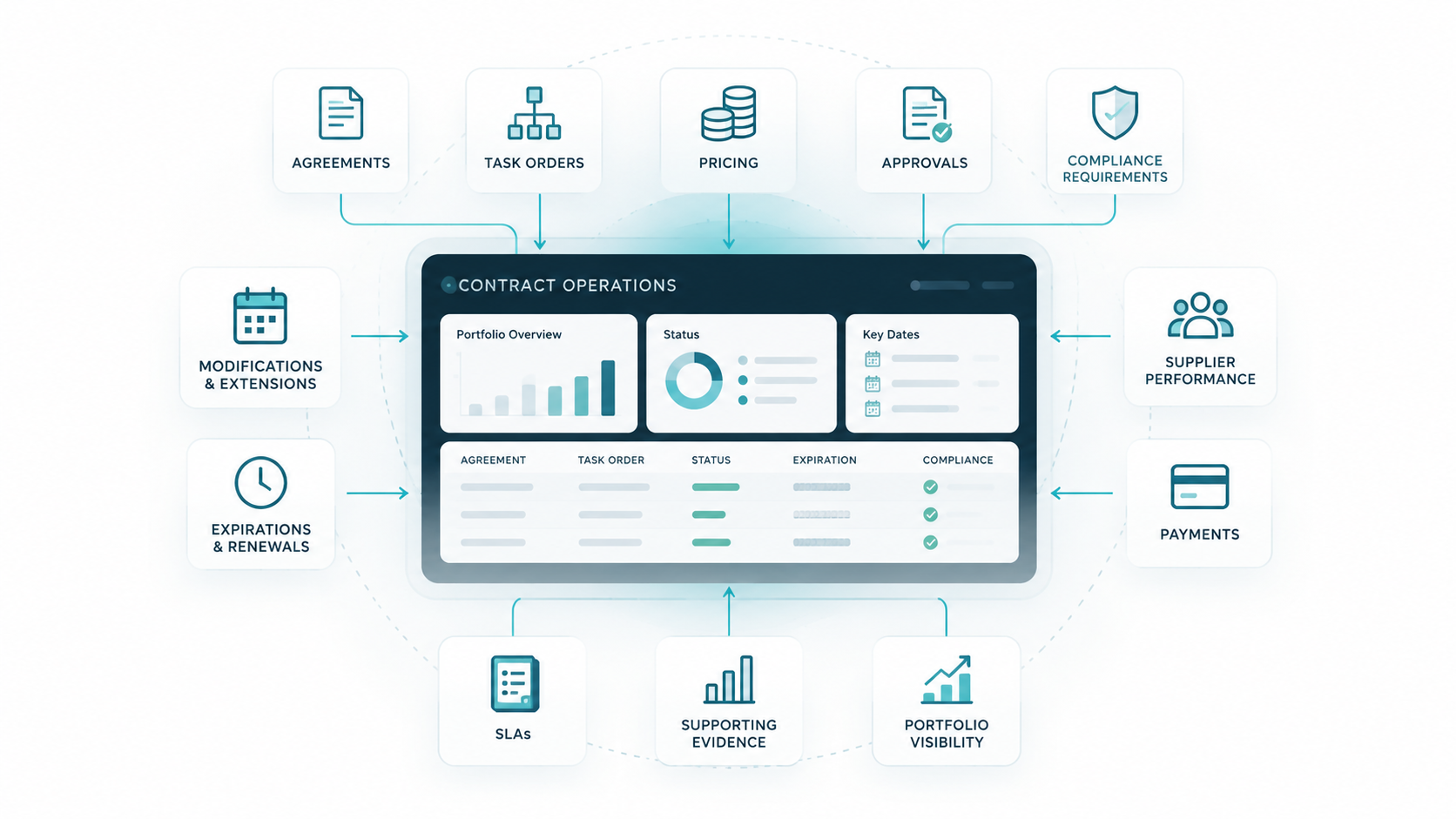
Designed an integrated contract operations control model connecting agreements, task orders, pricing, approvals, SLAs, supplier performance, payments, modifications, extensions, expirations, renewals, compliance requirements, and supporting evidence—improving traceability, audit readiness, lifecycle visibility, and portfolio control across a complex federal subcontract environment.
CONTRACT GOVERNANCE
COMPLIANCE & RISK
LIFECYCLE VISIBILITY
72% → 95%
CONTROL COMPLETENESS
Improved documentation and traceability
$300M+
PORTFOLIO VISIBILITY
Integrated subcontract lifecycle oversight
13 YEAR
LIFECYCLE CONTROL
Expirations, renewals, extensions & modifications, payments
THE PROBLEM
Current-State Performance Gap

Contract operations data and control evidence were distributed across multiple systems and manual tracking methods, limiting centralized visibility into agreement status, task orders, pricing, approvals, SLAs, supplier performance, payments, modifications, expirations, renewals, and compliance requirements. Control and documentation completeness were approximately 72%, requiring significant manual reconciliation, slowing identification of exceptions and upcoming obligations, and increasing audit and compliance exposure across the subcontract lifecycle.

Observed Friction

  • 72% control/documentation completeness — incomplete or difficult-to-trace evidence
  • Multiple data sources — significant manual reconciliation required
  • Limited lifecycle visibility — expirations, renewals, extensions, and modifications tracked separately
  • Fragmented obligation tracking — approvals, SLAs, payments, and supplier performance lacked a unified view
  • Delayed exception identification — risks and upcoming actions were harder to surface early
  • Limited lifecycle visibility — expirations, renewals, extensions, and modifications tracked separately
BEFORE → AFTER WORKFLOW

From Fragmented Oversight to Integrated Lifecycle Control

BEFORE

Fragmented & Reactive

Agreement Data → Task Order Tracking → Pricing Files → Approval Emails → SLA Tracking → Supplier Performance → Payment Status → Modifications & Extensions → Expiration / Renewal Tracking → Compliance Evidence → Manual Reporting
MULTIPLE SOURCES | MANUAL RECONCILIATION | LIMITED TRACEABILITY | REACTIVE LIFECYCLE TRACKING | INCREASED AUDIT EXPOSURE
AFTER

Integrated & Controlled

Agreement & Task Order Intake → Standardized Contract Data → Pricing & Approval Controls → SLA & Supplier Performance Monitoring → Payment & Modification Tracking → Expiration / Renewal Alerts → Compliance Evidence → Centralized Portfolio Reporting
INTEGRATED VIEW | DEFINED CONTROLS | PROACTIVE LIFECYCLE VISIBILITY | TRACEABLE EVIDENCE | STRONGER AUDIT READINESS
BUSINESS VALUE

Operational Improvement Translated Into Lower Risk and Greater Business Value.

The redesigned operating model reduced execution friction while improving visibility, accountability, control traceability, and audit readiness across complex federal subcontract operations.

OPERATIONAL OUTCOMES

More Efficient Execution

  • Fewer routing and approval handoffs
  • Shorter subcontract execution cycle
  • Clearer process ownership and accountability
  • Centralized workflow and status visibility
  • More complete and traceable control documentation
  • Clearer ownership of approvals, obligations, and required controls
BUSINESS OUTCOMES

More Predictable Performance

  • Faster progression from request to executable agreement
  • Greater confidence in delivery commitments
  • Earlier visibility into risk, dependencies, and exceptions
  • Less administrative effort spent reconciling status across systems
  • Reduced audit risk through stronger documentation, traceability, and control consistency
  • Improved audit readiness and leadership confidence in contract compliance
CONTROL & GOVERNANCE METHODOLOGY

A Structured Approach to Lifecycle Control and Compliance.

I combined contract lifecycle analysis, control design, compliance requirements, data architecture, and operational governance to create a more integrated, traceable, and audit-ready contract operations model.

01

Assess

Mapped the existing contract environment, data sources, ownership, lifecycle events, control gaps, compliance requirements, and audit exposure.

02

Define Requirements

Identified required controls, approval points, evidence, obligations, SLAs, renewal triggers, reporting needs, and compliance dependencies.

03

Architect Controls

Designed an integrated control model connecting agreements, task orders, pricing, approvals, supplier performance, payments, modifications, expirations, renewals, and supporting evidence.

04

Implement & Integrate

Built standardized tracking, control points, lifecycle alerts, reporting structures, and centralized visibility across contract operations.

05

Monitor & Improve

Established ongoing monitoring of control completeness, lifecycle events, exceptions, supplier performance, compliance evidence, and emerging portfolio risk.

"Excellence is never an accident; it is the result of high intention, sincere effort, intelligent direction, skillful execution and the vision to see
obstacles as opportunities."

— ANONYMOUS
LET'S CONNECT

Have a Complex Problem Worth Solving?

I'm always open to conversations about contracts, operations, process transformation, systems improvement, and meaningful work where better structure can create better outcomes.

CONTACT ME

EMAILPHONECHARLOTTEALWARD.COM
@ 2026 Charlotte Alward. All rights reserved.